




What is Vocalic R?
Vocalic R is a vowel sound influenced by the letter R, here the letter R becomes a part of the syllable, as in card, bard or bird. It is different from prevocalic R words, where the R letter comes before the vowel as in rabbit, red, rain, etc.
Before you continue
A vowel is a speech sound made with an open mouth, such as a, e, i, o, u, and when followed by R, the vowel changes its sound.
A syllable is a basic unit of speech consisting of an uninterrupted sound.
Difficulty in vocalic R words can impact clarity, communication and confidence. But the good news is that Vocalic R can be actually learned with constant and structured practice and the correct speech therapy methods.
Vocalic R vs Prevocalic R
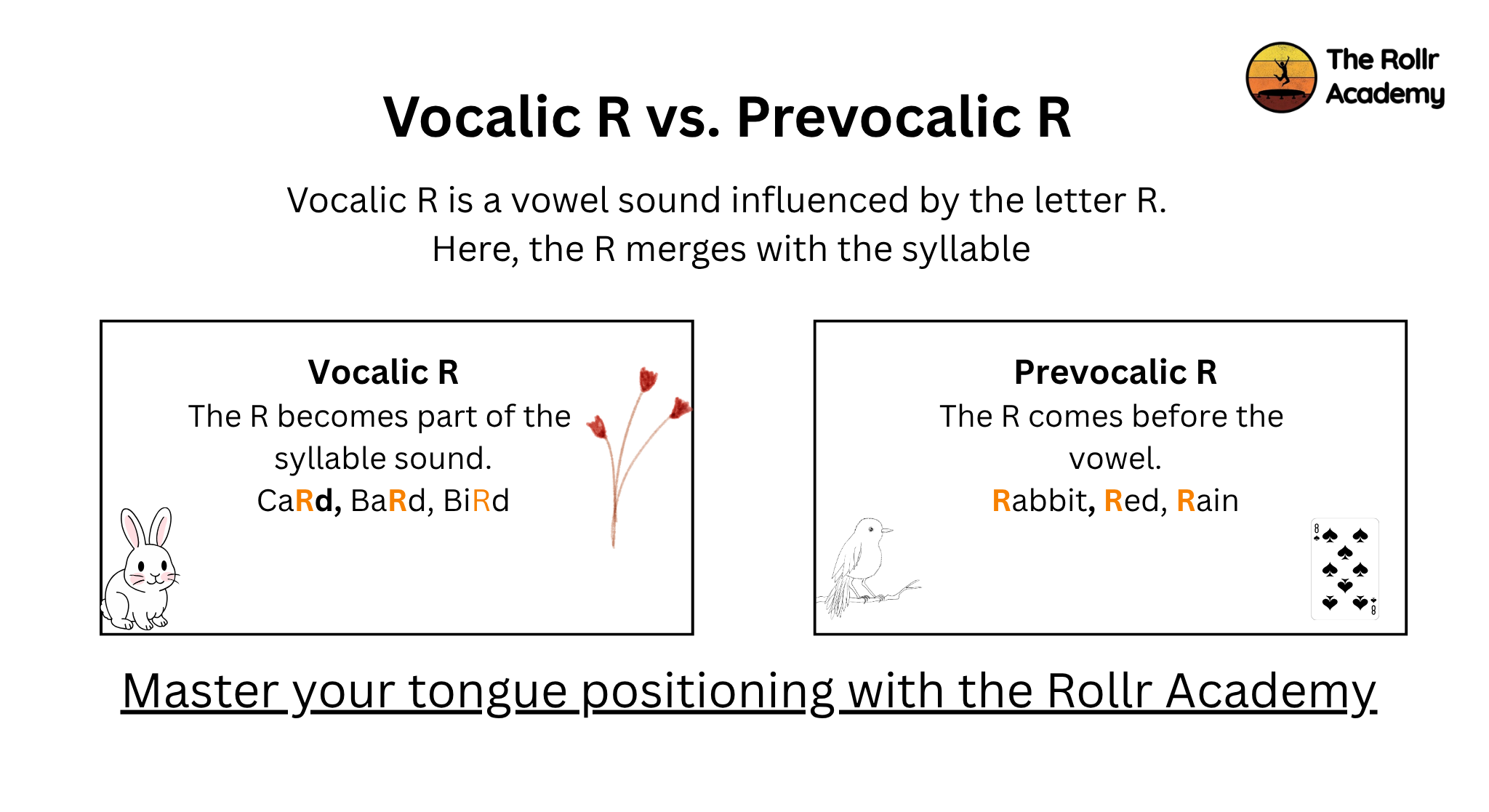
Ref: Explanation of Vocalic R & Prevocalic R differences
Learning the difference between Prevocalic R words and Vocalic R words can help you choose the right exercises.
| Feature | Vocalic R words | Prevocalic R words |
|---|---|---|
| The R position | After Vowel Letter | Before Vowel letter |
| Example | Bird, Car | Run, Red |
| Difficulty | Bit Complicated | Easy |
| Tongue Movement | Retracted Tongue | Forward Motion |
| Therapy Focus | Tongue tension and Vowel Control | Start of the sound |
| The Usual error | Unclear Vowel | W substitution |
Most of the learners do well in 'prevocalic R words' earlier than 'vocalic R words'.
Understanding Vocalic R
Vocalic R refers to the rhotacization of vowels in clinical phonetics, which means the vowel changes because of the R sound. The R sound has limited visual cues. Sounds like M or P can be seen on lips but vocalic R words usually happen inside the mouth, which makes it difficult to imitate.
Each group of Vocalic R words requires slightly different tongue positioning, which is why learners may find some types easier than others.
There are total 7 Major Vocalic R words / variations, which are:
| No. | Type | Symbol | Vocalic R words |
|---|---|---|---|
| 1 | AR | /ɑɹ/ | Far, Car, Bar |
| 2 | ER | /ɝ/ | Bird, her, deer |
| 3 | OR | /ɔɹ/ | Bore, sport, for |
| 4 | AIR | /ɛɹ/ | Fair, Chair, Hair |
| 5 | EAR | /ɪɹ/ | Fear, Near, Gear |
| 6 | IRE | /aɪɹ/ | Tire, fire, wire |
| 7 | RL | /r-l/ | Curl, Girl, Whirl |
Why Vocalic R Words are Harder Than Other Sounds
Vocalic R words need precise coordination between the: Tongue movement, Mouth Airflow and Motor coordination.
The tip of the tongue needs to lift upwards to touch the roof of the mouth and the back of the tongue is pulled slightly inside towards the throat. At the same time, the sides of the tongue are lightly pressed against the molars for better airflow through the center of the mouth. The airflow should move smoothly.
This movement creates the R sound, even a small incorrect positioning of the tongue, can change it entirely.
Example:
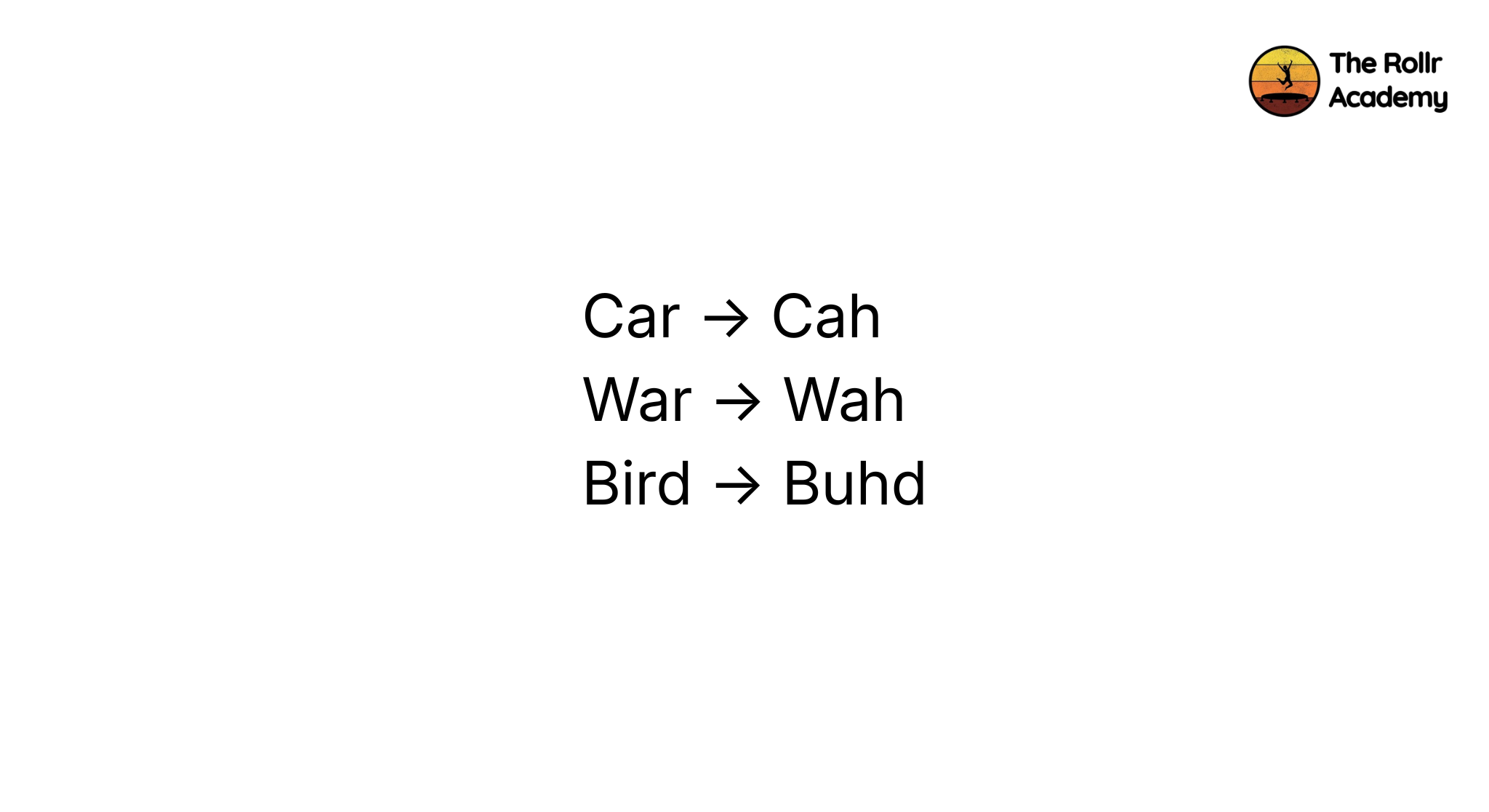
Ref: Example of how Vocalic R changes word pronunciation
Just a slight misalignment of tongue movements can turn the R into a W.
Hence, rhotacism errors are extremely common.
Speech Language Pathologists teach two tongue positions:
Retroflex R and Bunched R
- Retroflex R: In this sound, the tip of the tongue curls towards the roof of the mouth.
- Bunched R: The middle of the tongue lifts towards the palate.
And neither of these tongue shapes is better.
Sound therapies that use visual feedback generally help learners, creating perfect R sounds nearly 2.4 times faster than repetition methods.
Which simply means, when a learner watches the correct positioning of tongue when producing the R sound, can speed up the learning process.
Adults usually believe that it is too late to fix their Rhotacism. But the truth is people of all ages can improve pronunciation, can improve their R sound speech impediment or the difficulty to pronounce any other word at any age!
Ref: Rollr Academy Program "Growling" Method — visual biofeedback for R sound therapy at 1,700 Hz
150+ Vocalic R Words, Phrases, Sentences, and Reading Passages (Structured by Sound Type)
Here is a carefully curated Vocalic R word list designed to build accurate muscle memory and improve pronunciation efficiently. These words follow proven speech therapy progression patterns, helping learners practice the most effective sound combinations first.
Start practicing the ER Vocalic R words today for just 5 minutes:
The “ER” sound is often the easiest starting point as it is frequent in daily English words. Starting with the right sound can speed up the learning progress efficiently.
ER Vocalic R words
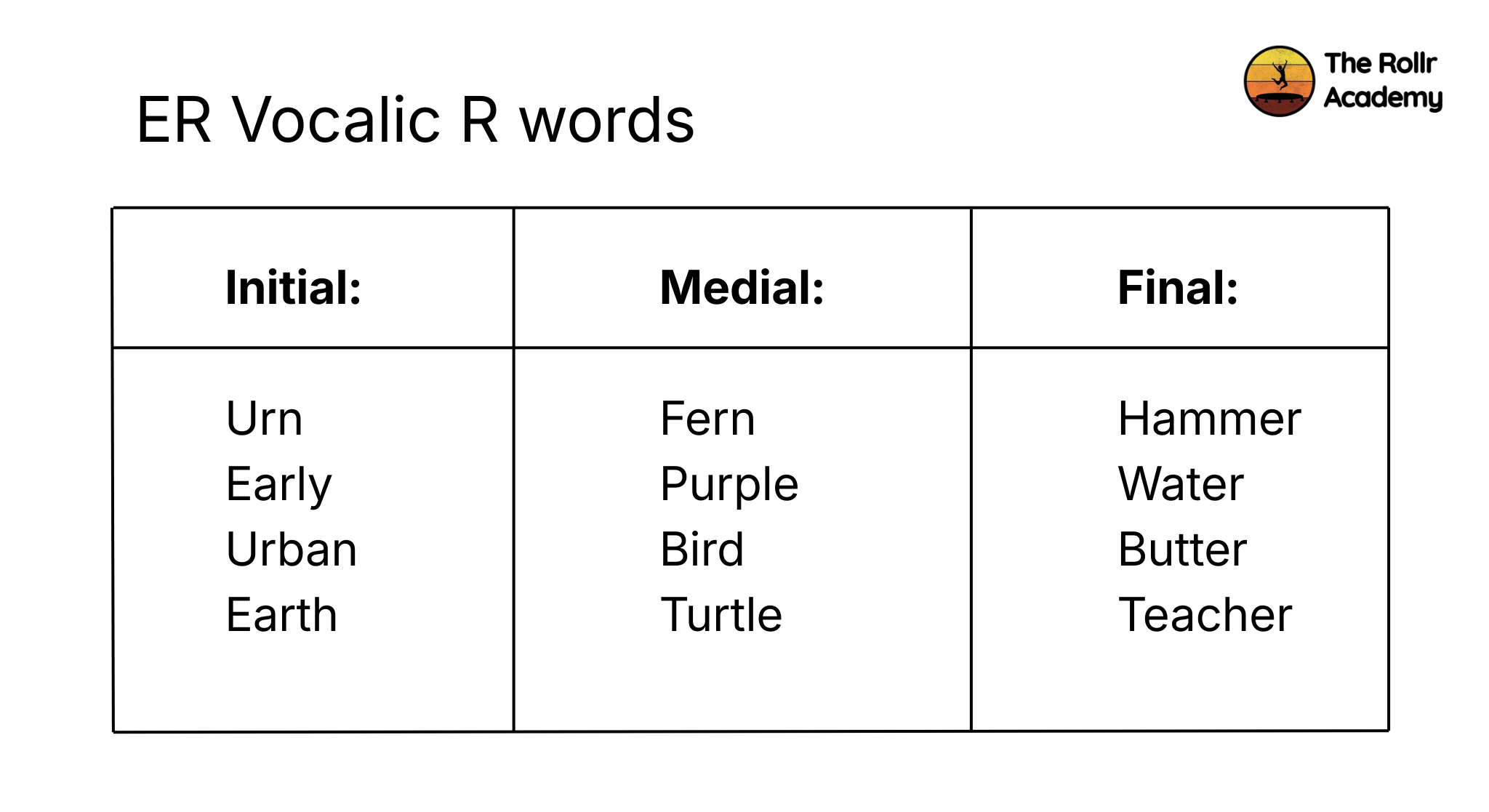
Tip: Repeat each word 5 times slowly. You can use the built-in timer and repetition counter in the practice tools to stay consistent and track your progress.
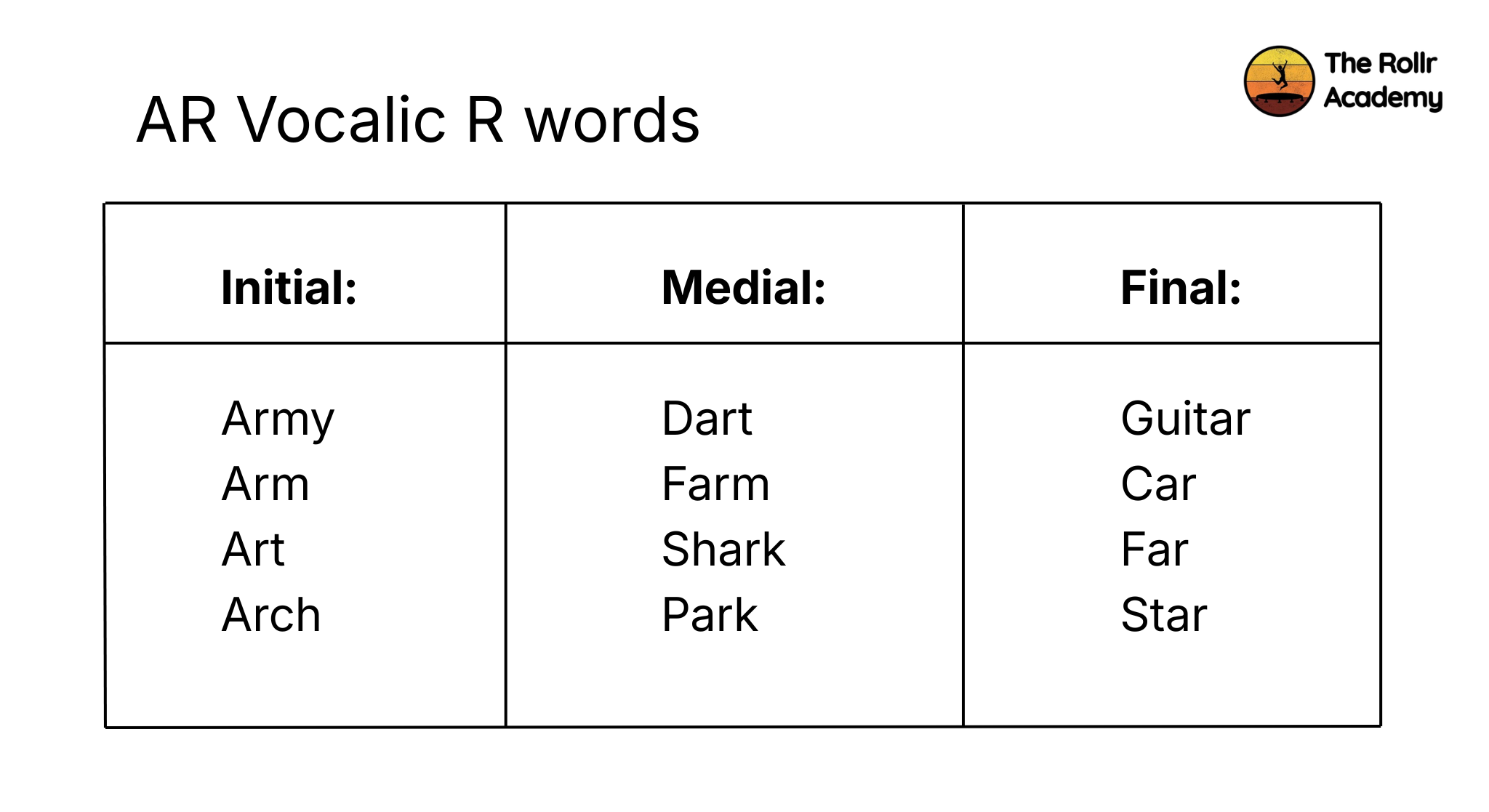
AR Vocalic R words
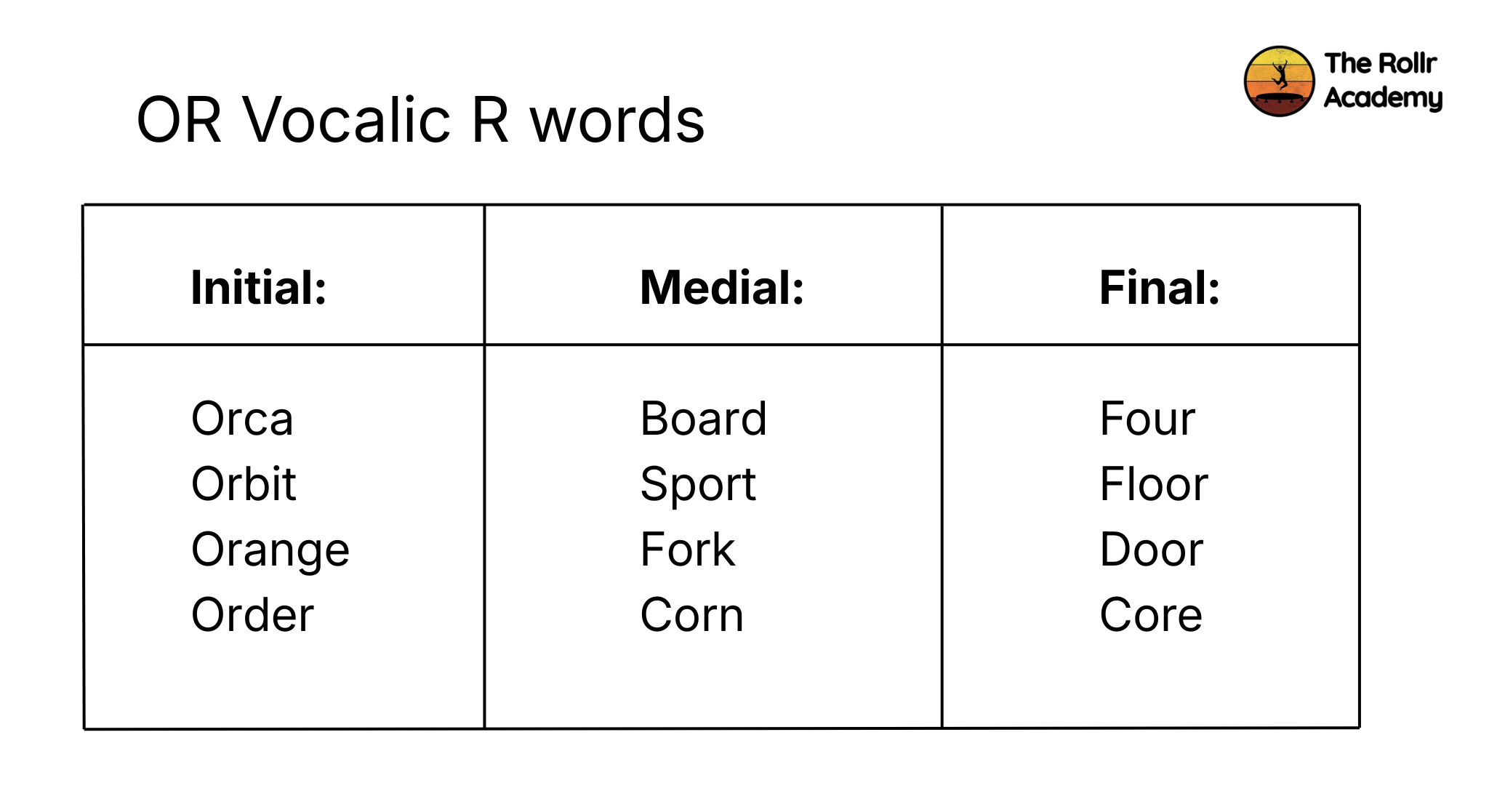
OR Vocalic R Words
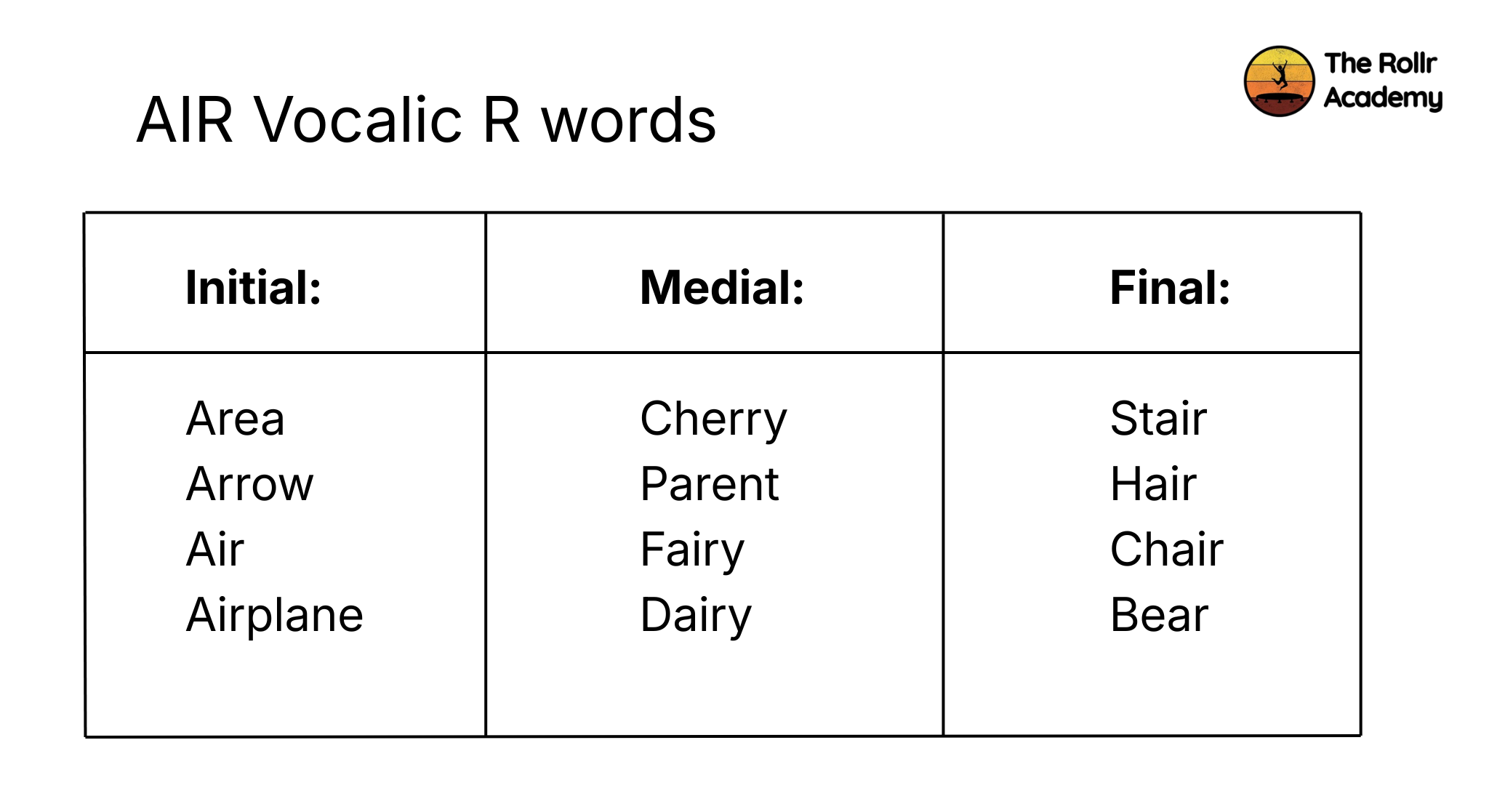
AIR Vocalic R words
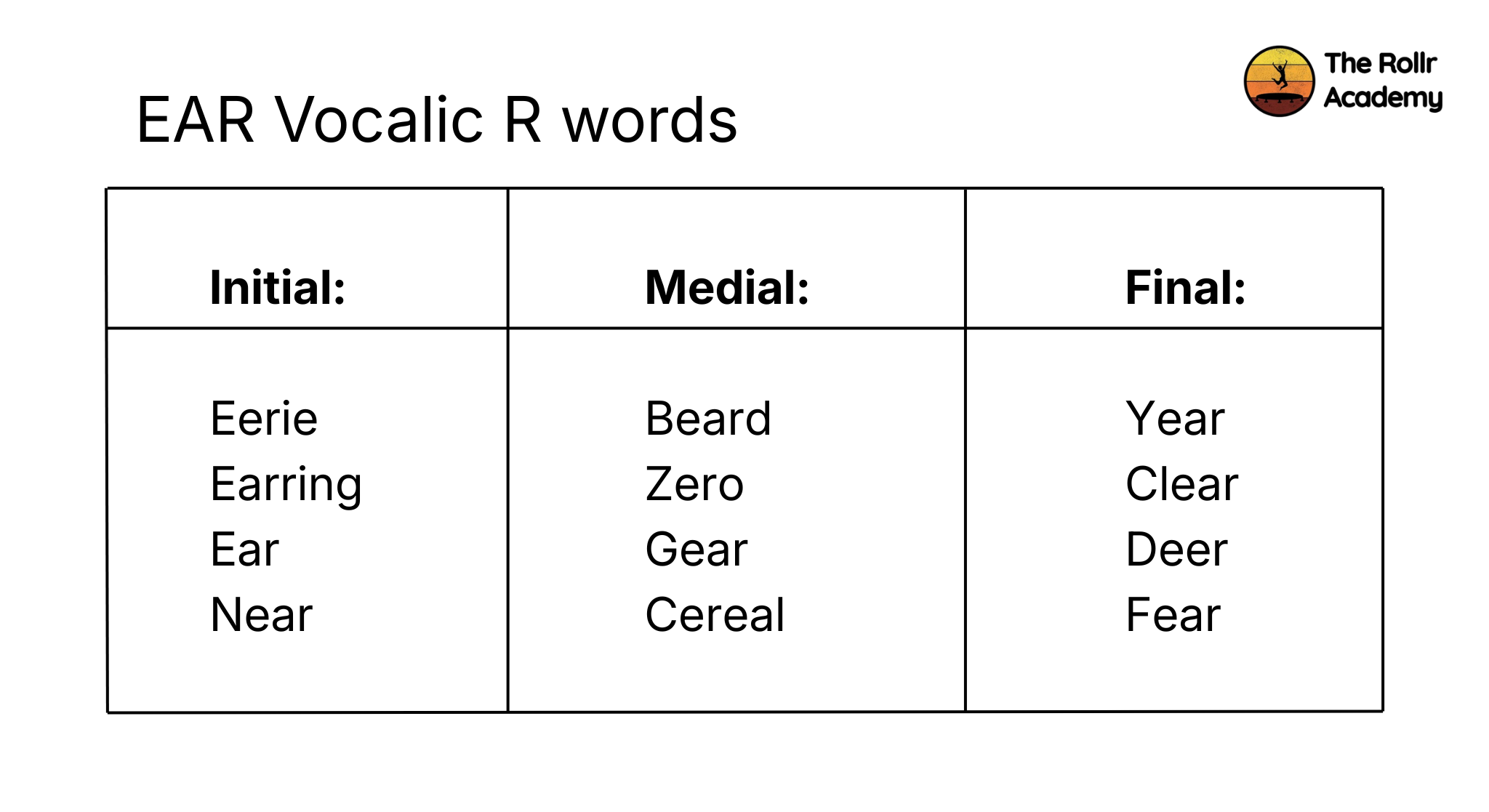
EAR Vocalic R words
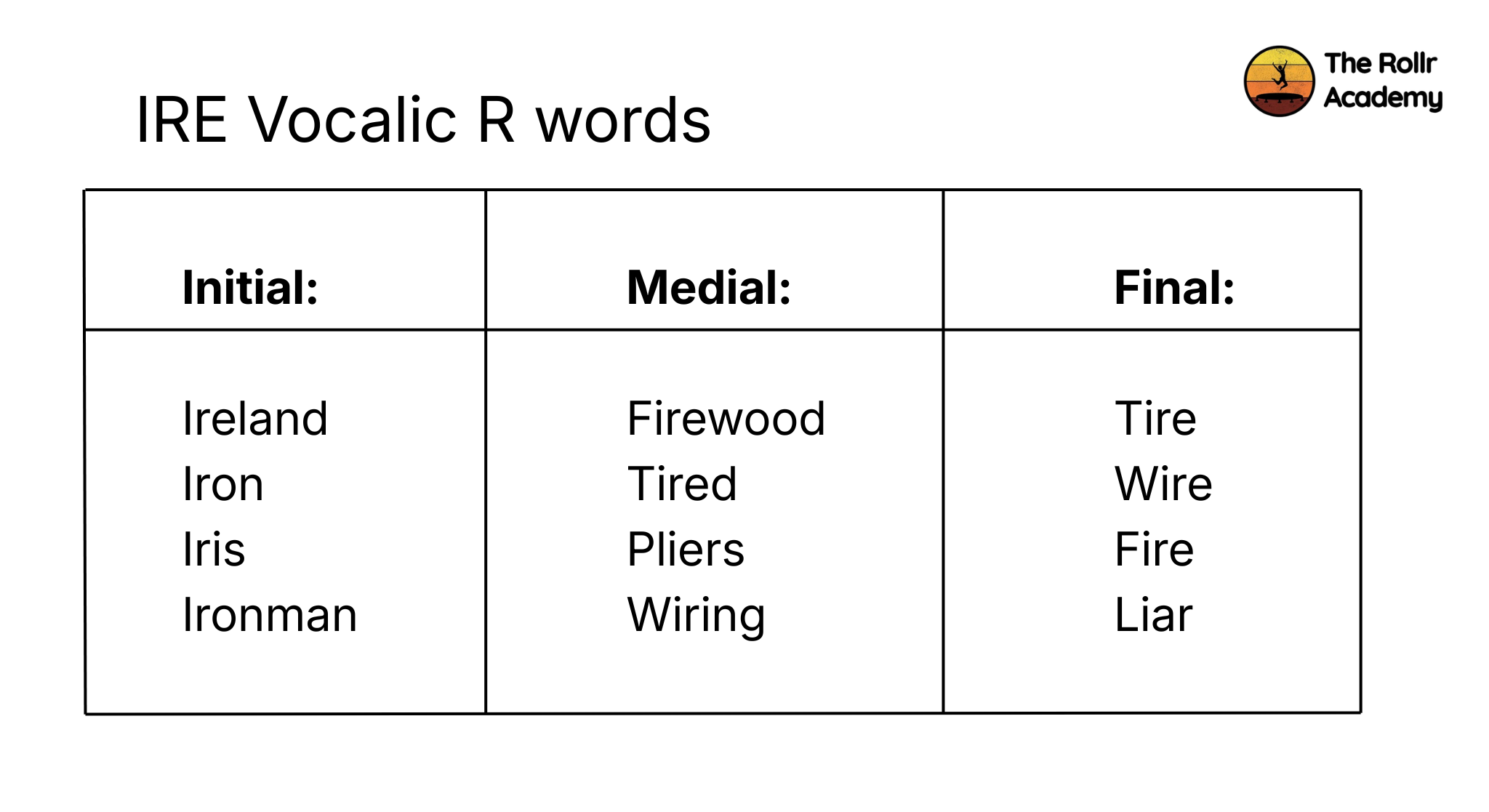
IRE Vocalic R words
RL Vocalic R Words
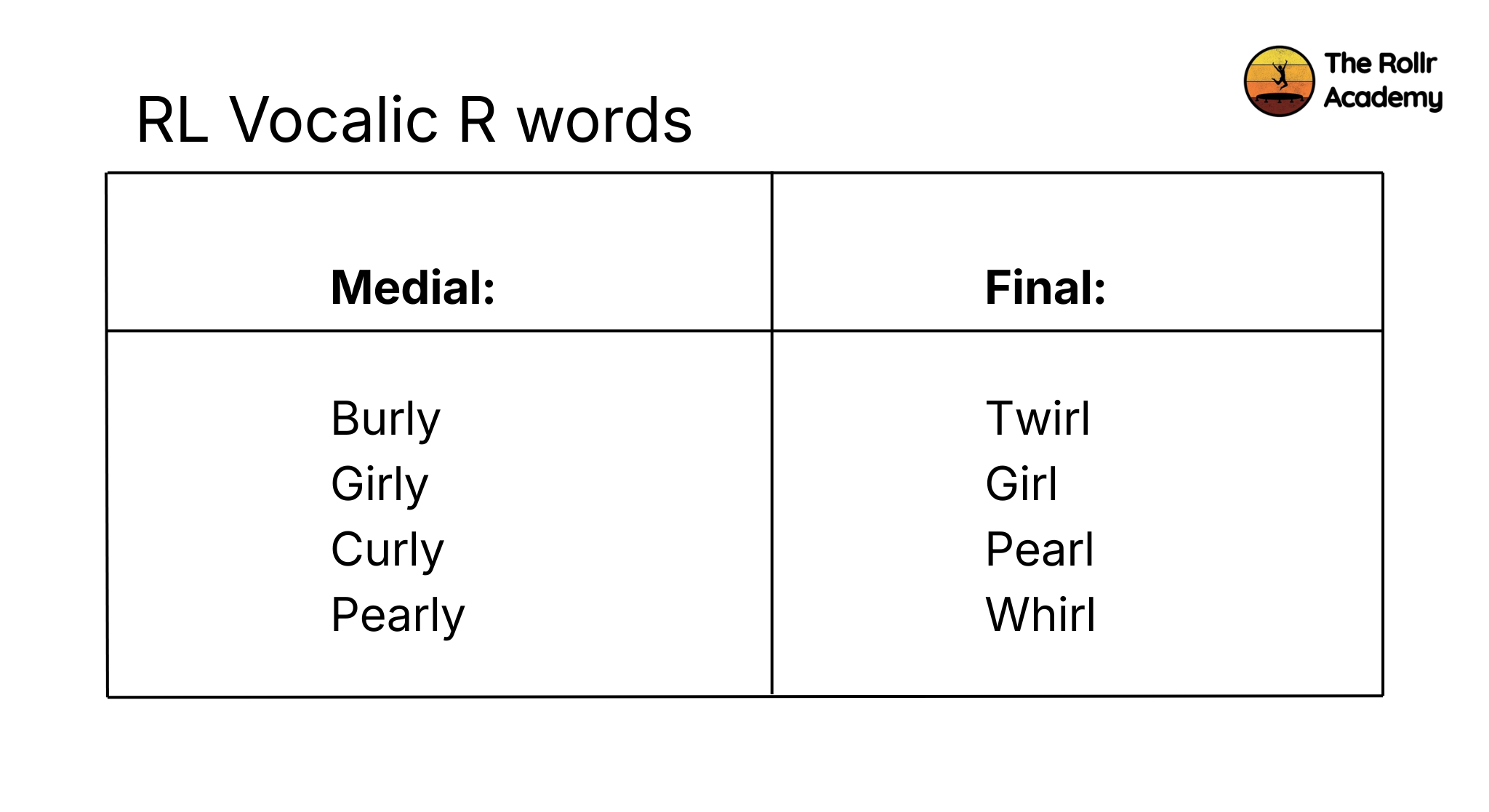
Get our comprehensive list to all 7 Vocalic R patterns. From "RL" combinations to complex sentences, we’ve mapped out 150+ ways to help you find your voice. Ready to print or practice on the go.
Vocalic R Sentences Practice
AR: The star is far
AIR: He has Long hair.
ER: The birds can sleep at night.
EAR: I can hear clearly.
IRE: The Liar has been caught.
OR: Clean the floor.
Reading Practice Using Vocalic R Words
The motor memory and the pronunciation can be strengthened by reading aloud some helpful sentences given below:
Please read these slowly and in repetition:
Tip: Use noise cancellation headphones to amplify your hearing feedback.
AR Reading
- The farmer drove the car, far near the park.
- A bright star appeared tonight.
AIR Reading
- The boy brushed his hair while sitting on a chair at the fair.
- The girl could sense fragrance in the air.
ER Reading
- The bird drank water near the white flower.
- The teacher told us to do better in the test tomorrow.
EAR Reading
- Every year, I hear a cheer near my ear.
- I can hear the hums every year.
IRE Reading
- The wire and tire were fixed when the fire grew.
- The fire was massive.
OR Reading
- I saw four animals.
- The door near the store was closed.
Tools and Techniques for Practicing Vocalic R
Shaping Technique:
It starts with a longer "shhhhh" sound which gradually pulls the tongue back and it turns into an R sound.
Daily repetition strengthens the speech motor patterns of the brain.
Speech therapy uses a set of versatile tools to achieve required outcomes such as tactile feedback tools providing physical cues for tongue placement, visual feedback tools to help with mouth position, smartphone/recording apps for consistent progress and oral-motor tools for strengthening & increasing coordination.
Do you know?
Speech learning is the same as any instrument learning such as piano or violin. The consistency of short practices creates stronger neural pathways as compared to the occasional long sessions.
Using Forbrain to Upgrade Sound Practice
Forbrain is a headset that gives auditory feedback that helps learners hear their own voice more clearly. It works on the foundations of how sound travels through bone conduction, just slightly modified. Which can enhance speech accuracy and awareness.
Exercises using forbrain:
- Practice speaking the ER word list for 5 minutes everyday.
- Read the Vocalic R words clearly and slowly.
- Read Vocalic R sentences aloud.
- Practice with a dedicated Vocalic R words worksheet while wearing the headset.
Consistency is effective. Short everyday sessions using the structured Vocalic R words can help improve the R speech impediment over time.
For better results, combine guided motor-learning practice with auditory feedback tools like the structured approach used by Top Speech Health.
Supporting Children with Vocalic R
Loved ones can help people with speech impediments progress faster with simple wins:
- Encouraging the effort
- Daily Practicing
- Avoiding pressure of any sort
- Celebrating even small wins
- Showing them how to pronounce certain words clearly
Confidence plays a vital role in speech learning.
How to Help Your Child Produce Vocalic R Words Correctly
Here's a step-by-step procedure that you can incorporate:
- Start with the ER Vocalic R words.
- Let them practice slowly.
- Use Mirror feedback as much as they can.
- Repeat tricky words multiple times.
- Slowly let them progress to sentences.
- Celebrating every small win, boosts confidence.
Small everyday practices create an immense improvement.
Structured Support for Persistent R Errors with Top Speech Health
It doesn't matter what your age is, structured speech therapy can immensely improve clarity in speech.
We, at Top Speech Health, offer a motor-learning based structured program that is specifically designed for R sound impediments including Residual Speech Sound Disorder, and Rhotacism.
The program:
- Focuses specifically on difficult R sounds.
- Provides structured progression.
- Uses evidence-based speech improvement techniques.
- Integrates Motor learning principles.
Many learners struggle for years not because they lack guidance, but because consistent daily practice is difficult to maintain without structured support.
Get started by downloading the Top Speech Health program today.

Conclusion
Now that you have read the blog, you understand that Vocalic R words are one of the most complicated speech sounds, but improvement is achievable with proper structured and daily practice.
The 7 vocalic R words / variations discussed in this article are AR, ER, OR, AIR, EAR, IRE, and RL, each require slightly different tongue positioning and practice approaches.
- Start little
- Practice daily
- Build gradually
- Repeat until clear speech develops.
Frequently Asked Questions
Vocalic R words contain a vowel which is followed by an R, such as far, bar, car, hair, liar etc.
The ER sound is often the easiest Vocalic R because the tongue stays in a neutral mid-mouth position, making it easier to maintain correct tension and airflow. Words like bird, teacher, and water provide a stable starting point for practice.
Absolutely, anyone of any age can correct Rhotacism by a structured speech training.
Sources and Clinical Research
The following peer-reviewed studies, clinical guidelines, and authoritative resources informed this article.
ASHA Practice Portal: Speech Sound Disorders – Articulation and Phonology
Clinical guidelines and evidence maps for assessment and treatment of articulation and phonological disorders.
View SourceMcAllister Byun, T. et al. (2025). Rhotic Acquisition Is More Rapid in Biofeedback Than Motor-Based Treatment for Residual Speech Sound Disorder. Journal of Speech, Language, and Hearing Research.
Landmark RCT showing biofeedback accelerates /r/ acquisition 2.4x compared to traditional motor-based therapy.
View SourceMontclair State University: Groundbreaking Speech Therapy Research Helps Child Master the R Sound in Weeks
Research demonstrating effective speech therapy approaches for mastering R sound production.
View SourceUniversity of Cincinnati: Speech and Hearing Clinic
Clinical resource for speech and hearing disorders including articulation therapy services.
View Source